☮️✨ Creative Development by Normalizing Activation
Creative development is the process of entering activation and normalizing that activation into expression.
Activation builds:
- simultaneity,
- intuitions,
- impressions,
- symbolic tension,
- emotionality,
- perceptual movement,
- cognitive pressure,
- experiential density.
Expression becomes the normalization of that activation into structured form.
Without activation, there is no movement toward creation.
Without normalization, activation becomes fragmentation, overload, agitation, or paralysis.
Creative development therefore depends on building sustainable activation-normalization loops appropriate to the configuration of the mind.
This framework emerged from documenting my own instinctual writing process while developing the Naturopathic Engineering series, but the process can be generalized because different mind configurations appear to require different activation interfaces.
One side of creativity is activation. The other side is normalization.
Activation creates movement. Normalization gives movement form.
The Creative Duality
This duality appears throughout creativity:
- intuition and structure,
- inspiration and execution,
- simultaneity and sequence,
- pressure and release,
- immersion and articulation,
- perception and wording.
A creator develops by learning how to intentionally enter activation and then normalize that activation constructively.
The resulting form may become:
- words,
- music,
- movement,
- visual art,
- systems,
- games,
- simulations,
- technologies,
- architecture,
- social structures,
- or interfaces.
Activation Begins Through Life
The activation itself usually does not begin while sitting at home trying to create. Activation begins while living.
You move through environments.
You walk through cities.
You encounter people, systems, atmospheres, weather, sounds, textures, tensions, memories, bodily sensations, intuitions, symbolic moments, and emotional reactions.
The intuitions emerge spontaneously while interacting with life itself.
The problem is that these intuitions are highly simultaneous and unstable.
By the time the creator returns home and attempts to externalize them sequentially through wording, much of the activation has already dissipated.
This creates a fundamental difficulty:
the intuitions exist intensely during experience, but weaken when the creator attempts to sit down and structure them consciously.
For this reason, the function of the activation medium is not merely aesthetic or decorative. Its function is anchoring.
The creator associates a medium with the simultaneous field of intuitions experienced throughout life.
The medium becomes a retrieval interface for activation.
Structural Foundation Before Activation
Before activation media is developed, the philosophical structure itself must exist. The workflow therefore begins structurally.
The creator first defines:
- the books,
- the sections,
- the modules,
- and the conceptual architecture of the project.
The structure acts like a skeleton around which activation later organizes itself.
Only after the structural foundation exists can activation become intentionally directed.
Entry Maps as Simultaneous Structure
After the modules are defined, an entry map is created.
Initially, chromatic entry maps were developed because colors and spatial organization allowed many intuitions to coexist visually before wording forced sequentiality.
The colors were not decorative.
The spatial organization was not merely organizational.
They stimulated simultaneity.
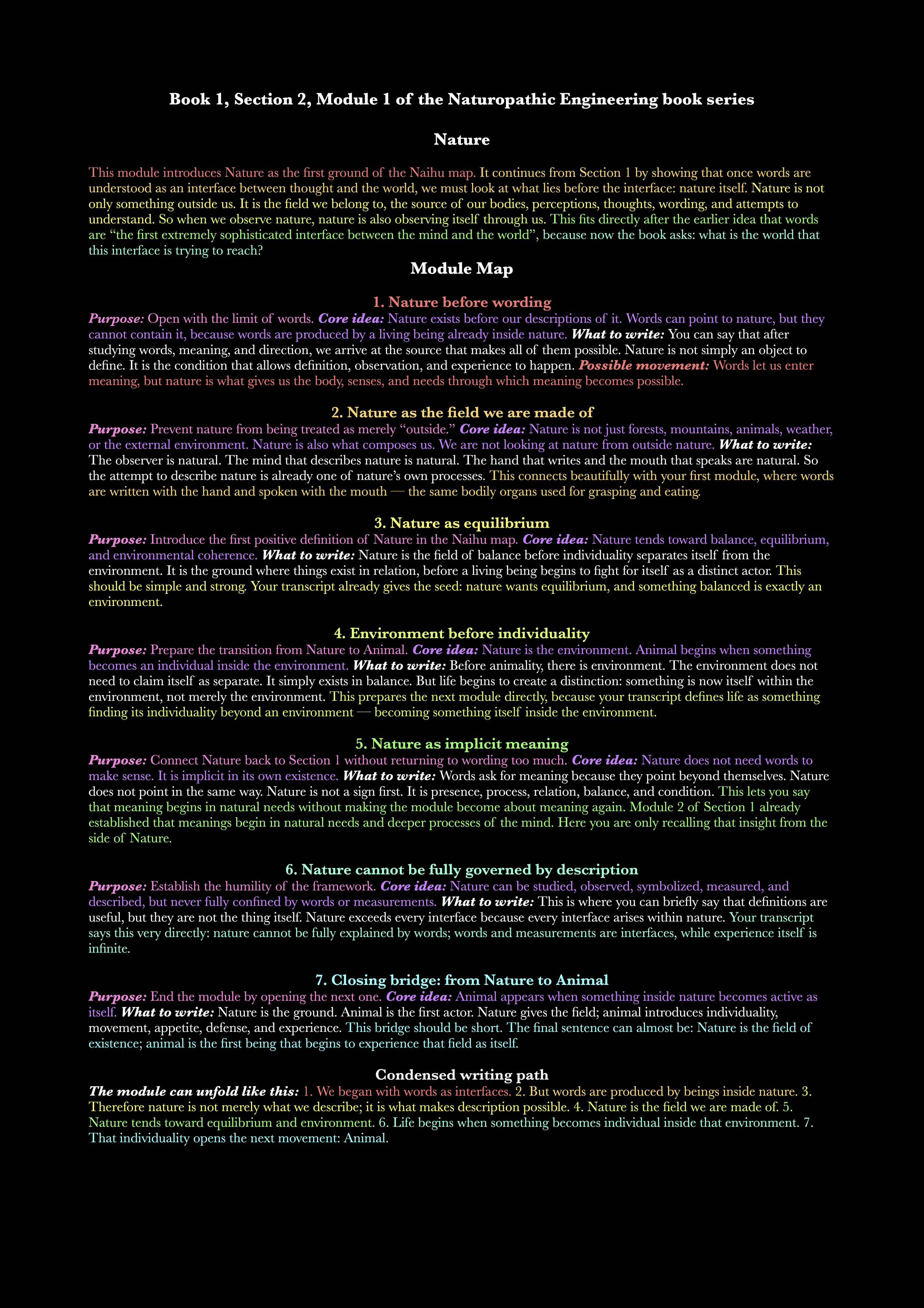
Chromatic map for the Nature module. The colors organize the voiceover into conceptual movements, turning simultaneous insight into a visible sequence for writing, image generation, and video development.
The entry map allowed multiple conceptual movements to remain visible at once before they were transformed into sequential wording.
Later, this process evolved further.
The chromatic entry map became less important as a direct activation system and more important as:
- a simultaneous conceptual overview,
- a structural condensation layer,
- a bridge between module structure and future activation media.
The entry map now acts primarily as:
- a structural interface,
- a simultaneous conceptual map,
- and the basis for voiceover construction.
Voiceover as Sequential Crystallization
After the entry map is established, a voiceover is created from the structure.
The voiceover transforms simultaneous conceptual movement into sequential wording.
This becomes important because:
- reality is fundamentally simultaneous,
- while wording unfolds sequentially.
The voiceover therefore becomes:
- the sequential spine of the module,
- the verbal crystallization of simultaneity,
- and the structural foundation for activation media.
Different Mind Configurations Require Different Activation Interfaces
Different minds enter activation differently.
Some people enter activation through:
- images,
- music,
- movement,
- systems,
- environments,
- emotional immersion,
- social interaction,
- bodily tension,
- simultaneity,
- intellectual compression,
- symbolic resonance.
Creativity is therefore configuration-dependent.
Different minds accumulate and normalize activation differently.
Instinctual Activation
The discoveries that led to this framework emerged primarily through instinctual writing. Instinctual cognition appears highly sensitive to:
- immediacy,
- embodiment,
- simultaneity,
- environmental stimulation,
- symbolic compression,
- intuitive impact,
- movement,
- perceptual density,
- autobiographical resonance.
The instinctual mind often does not naturally remain inside prolonged emotional continuity or purely abstract sequential reasoning.
It requires an explosive entrance into simultaneity.
For this reason, activation interfaces become extremely important. The instinctual writer may require:
- symbolic sequences,
- movement,
- perceptual immersion,
- atmospheres,
- textures,
- visual density,
- emotional tension,
- environmental resonance,
- symbolic unpredictability.
The purpose is not merely to generate ideas.
The purpose is to construct sufficient activation pressure for spontaneous wording to emerge.
Why Spontaneity Matters
The writing must remain spontaneous because the reader is not only receiving information. The reader is experiencing the movement of thought itself.
If activation is weak, wording becomes mechanically explanatory.
The concepts may still exist intellectually, but the writing loses:
- rhythm,
- pressure,
- continuity,
- symbolic movement,
- experiential flow.
But when wording emerges spontaneously from activation, the writing preserves traces of the simultaneous experience from which it emerged.
The reader then experiences:
- movement,
- continuity,
- perceptual flow,
- symbolic density,
- emotional rhythm,
- living cognitive motion.
This realization became extremely important.
The activation process was not merely helping the writer “have ideas.”
It was preserving the living flow of thought so that the reader could experience the movement of the writing itself.
Activation Media
At first, the activation process developed through chromatic text and entry maps. The colors and spatial organization helped restore simultaneity before writing. But the process eventually evolved beyond static text.
The activation system now requires media.
Activation media can include:
- generated images,
- found images,
- videos,
- personal footage,
- symbolic fragments,
- environmental material,
- textures,
- diagrams,
- music,
- movement,
- or any medium capable of carrying resonance.
The specific source of the media is secondary.
What matters is whether the media activates the right internal state.
The media is not chosen only to illustrate the voiceover literally. It is chosen to create symbolic, perceptual, emotional, instinctual, and memory-based activation around the structure.
This means activation media functions as:
- a retrieval interface,
- a symbolic environment,
- a perceptual bridge,
- a memory structure,
- and a way to reconnect sequential wording to simultaneous experience.
For instinctual writing, visual and moving media are especially important because they can create an immediate explosion of impressions. Images and videos can compress many intuitions into a single perceptual moment.
For emotional writing, music may often function better because it creates continuity, atmosphere, rhythm, and prolonged immersion.
So the medium changes according to the configuration of the mind.
The important point is not whether the material is generated, recorded, found, or collected.
The important point is that the activation media helps the writer enter the state from which spontaneous wording can emerge.
Module-Specific Activation Archives
Different philosophical states require different perceptual environments. This means the activation archive itself becomes part of the interface.
Separate activation reservoirs may emerge for:
- Nature,
- Dualities,
- Systems,
- Mind Configurations,
- Reactions and Normalizations,
- Propositions,
- Emotionality,
- Instinctuality,
- Society,
- Environments.
For example, the Nature module does not simply require beautiful landscapes.
It requires perceptual material related to:
- equilibrium,
- cycles,
- emergence,
- roots,
- fungi,
- weather,
- water,
- environmental relation,
- decay,
- growth,
- systems before individuality,
- and the nature of things themselves.
The activation process therefore becomes:
- entering the philosophical state of the module,
- gathering resonant media fragments,
- sequencing them around the voiceover,
- and allowing symbolic associations to emerge afterward instead of forcing literal illustration beforehand.
Emotional Activation
An emotional writer may enter activation differently.
The emotional mind may already sustain strong internal continuity of imagery and emotional immersion.
For this reason, emotional writers may require less explosive perceptual simultaneity and more prolonged continuity.
Music may therefore become the activation interface.
Music creates:
- immersion,
- continuity,
- atmosphere,
- rhythm,
- emotional flow,
- prolonged emotional movement.
The emotional writer may move through life accumulating:
- atmospheres,
- emotional impressions,
- lived experiences,
- memories,
- emotional states.
The music then becomes associated with those experiences.
Later, when the same music is played again, the emotional continuity is reactivated. The emotional writer re-enters the emotional field connected to those lived experiences.
Music therefore becomes:
- an emotional retrieval mechanism,
- a continuity anchor,
- an immersion interface,
- and a memory activator.
This creates an important distinction:
- instinctual activation tends toward explosive simultaneity,
- emotional activation tends toward immersive continuity.
Images and perceptual fragments often activate instantly. Music generally activates progressively.
Activation as the Real Work
This process initially appeared inefficient because the actual writing itself could happen very quickly once activation was reached.
But eventually it became clear that, for instinctual creativity, activation itself is part of the work.
The creator may spend hours, days, or weeks accumulating:
- impressions,
- symbolic associations,
- environmental resonance,
- perceptual continuity,
- emotional tension,
- intuitive movement,
- and simultaneous density.
Then the writing itself may normalize all of that in only a short period of spontaneous crystallization.
The writing therefore becomes the release phase of accumulated activation.
The preparation is not separate from the work.
The preparation constructs the conditions necessary for spontaneous wording to emerge.
The Complete Workflow
The workflow can be understood as:
1. Define the books.
2. Define the sections.
3. Define the modules.
4. Build the entry map.
5. Create the voiceover from the entry map.
6. Find or create activation media for the voiceover.
7. Sequence the activation media over the voiceover.
8. Use the activation video to enter writer mode.
9. Normalize activation into spontaneous wording.
Creativity as Interface Construction
Creativity is not merely invention.
Creativity is often the normalization of activation into structured form. Words are only one interface among many.
Images, videos, music, systems, games, environments, simulations, and symbolic structures can all become interfaces between the mind and the world.
The activation workflow itself becomes an interface:
- between simultaneity and sequence,
- between life and wording,
- between perception and structure,
- between activation and normalization.
This reflects the same foundational insight that generated the philosophy itself: reality is fundamentally simultaneous, while wording is sequential.
The activation process exists to reconnect sequential writing to the simultaneous experiential field from which meaningful thought originally emerges.
This note was developed with AI assistance from Mylan’s original concepts, conversations, and editorial direction.